Executive Summary
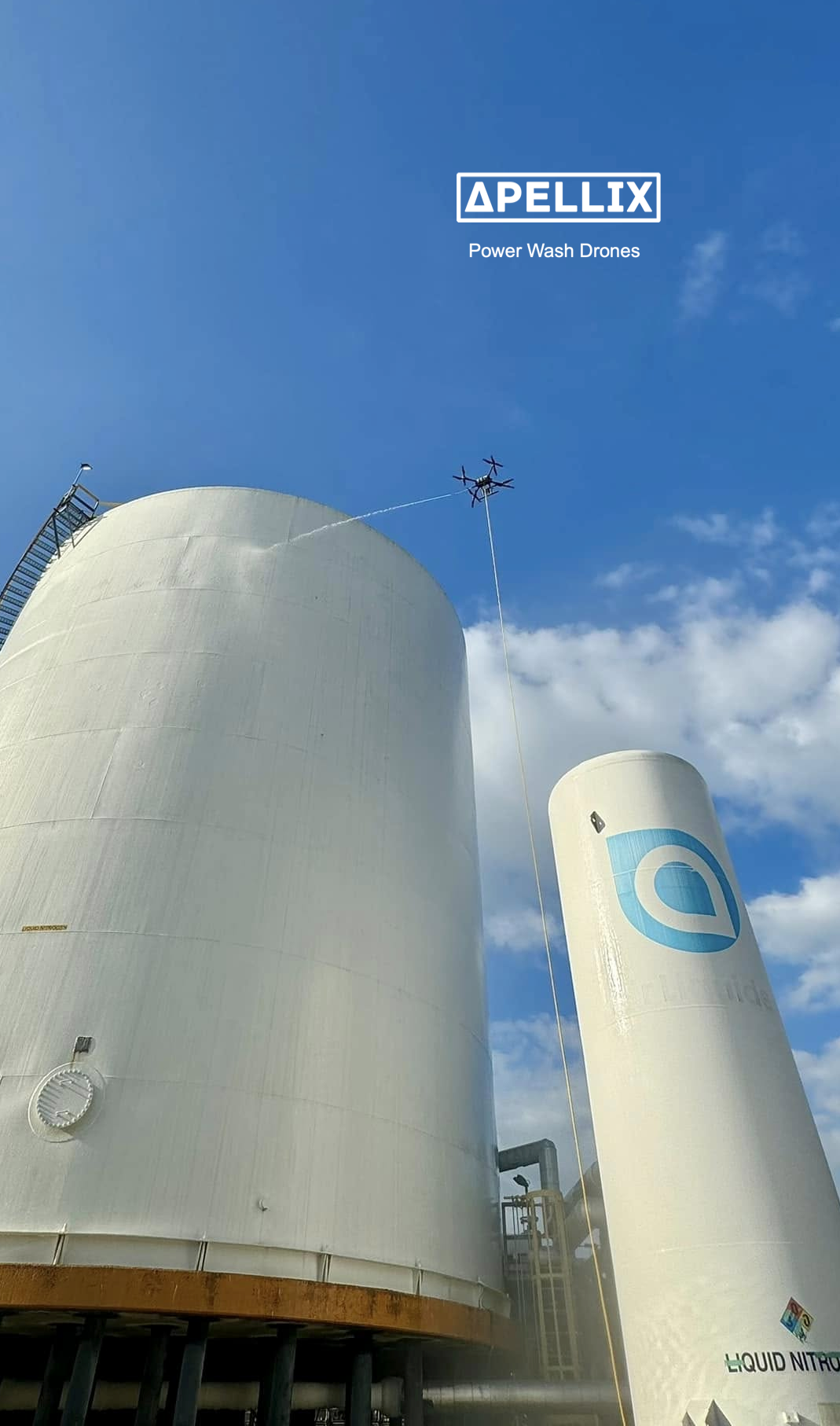
CleanFlight Solutions, an FAA-certified drone-powered exterior cleaning provider headquartered in St. Petersburg, Florida, deployed an Apellix semi-autonomous power-wash drone to clean the exterior of a Raymond James Financial Center in St. Petersburg, FL.
The project — which, for the past decade, has required approximately 11 days using conventional swing-stage and scaffolding methods — was completed in approximately 11 hours, representing a ~90% reduction in project duration and a strong improvement in cleaning throughput.
The Raymond James building is a curved, multi-story glass and stone-clad office building featuring full-height curtain-walls and continuous horizontal banding across each floor. The Apellix drone-based deployment eliminated the need for elevated worker access, removed scaffolding and rigging costs, and condensed multi-day occupant disruption into 11 hours of work.
This case study documents the operational metrics, ROI drivers, operator credentials, and technical specifications relevant to commercial property managers, facility operations leaders, and building owners evaluating drone-powered exterior maintenance.
Key Performance Metrics
Metric
Conventional Method
Drone-Powered (CleanFlight / Apellix)
Improvement
Project duration
~11 days
~11 hours
90% reduction
Workers at height
Multiple, suspended hundreds of feet
Zero
100% reduction in fall exposure
Scaffolding / swing-stage rigging
Required
Not required
Eliminated
Occupant disruption
Multi-day, high
Single or two days, low
Materially reduced
The Challenge
Cleaning the exterior of a multi-story commercial building such as the Raymond James Financial Center typically requires one or more of the following access methods:
- Swing stages (suspended platforms rigged from the roof)
- Scaffolding erected from the ground or anchored to the façade
- Boom lifts and aerial work platforms (where ground access permits)
- Rope-access (industrial abseiling) crews
Each approach introduces material cost, schedule, and risk factors:
- Worker safety exposure. Falls from height remain one of the leading causes of fatalities in the construction and building-services industries. Suspending personnel on the order of 70–90 feet above grade for multi-day periods materially increases liability exposure for both the service provider and the property owner.
- Setup and teardown overhead. Swing-stage and scaffolding setup can consume one or more days before any actual cleaning begins, and a comparable amount of time at project end. On curved façades, multiple rigging configurations are typically required to clean the full elevation.
- Anchor and rigging requirements. Code-compliant roof anchors must exist or be retrofitted; rooftop signage and parapet treatments can complicate rigging paths.
- Occupant disruption. The Raymond James Financial Center is an active corporate headquarters with thousands of staff; multi-day exterior maintenance projects affect tenant experience, generate noise, obstruct windows, and can require temporary closure of pedestrian areas at grade.
- Weather sensitivity. Tampa Bay weather windows are tight, particularly during convective-storm season; crews working at height face stricter weather restrictions than ground-based operators, extending project timelines further.
CleanFlight Solutions used drone-powered cleaning as an alternative to the conventional 11-day swing-stage approach.
The Operator: CleanFlight Solutions
CleanFlight Solutions is an FAA-certified, woman-owned commercial drone exterior cleaning company headquartered in St. Petersburg, Florida, serving the Tampa Bay region and clients nationwide. Notably, the operator and the customer asset are both located in St. Petersburg — this was a local-market deployment at the international headquarters of one of the largest financial services firms in the region.
Results and ROI Analysis
1. Time-to-completion: 90% reduction
The most direct and quantifiable outcome was the compression of project duration from 11 days to ~11 hours — a 90% reduction. For property managers, this translates to:
- Faster restoration of full façade aesthetics ahead of leasing tours, or scheduled events
- Reduced scheduling conflicts with tenant operations, deliveries, and pedestrian access
- Higher annual cleaning frequency feasibility within the same maintenance budget
- Ability to schedule the work into a single weekend window — completely outside business hours for the headquarters
2. Equipment and Access Cost Avoidance
The deployment eliminated the following line items entirely or substantially:
- Swing-stage rental and rigging
- Scaffolding rental, erection, and dismantling
- Roof-anchor engineering review or retrofitting
- Boom lift / aerial work platform rental
- Specialty rigging adjustments required for curved-elevation geometry
For high-rise assets, these line items can represent a significant portion of total project cost — often comparable to or exceeding the labor cost itself.
3. Safety: Eliminating Fall Risk
By keeping all personnel at ground level, the project achieved a 100% reduction in worker-hours at height compared to the conventional baseline. This has direct insurance and liability implications:
- Reduced workers’ compensation exposure for the service provider
- Reduced third-party liability exposure for the property owner — meaningful at a financial-services HQ with significant brand-protection considerations
- Simplified site safety planning and OSHA compliance documentation
- Elimination of fall-arrest equipment inspection and certification overhead
4. Occupant and Operational Disruption Reduction
A multi-day swing-stage operation at a corporate headquarters typically results in:
- Workers visible at executive and trading-floor windows over multiple days
- Noise from rigging, motors, and crew communication during business hours
- Restricted pedestrian access at building perimeter
- Repeated daily setup and teardown cycles
The drone-based deployment compressed all of this into 11 hours, no rigging at occupied window levels, and the ability to schedule entirely outside business hours.
Strategic Implications for Commercial Real Estate
The Raymond James Financial Center deployment reflects a broader operational pattern emerging in commercial building maintenance: the highest-leverage productivity gains from robotics are appearing in physical, hazardous, vertical-access work — not exclusively in white-collar automation. Buildings represent a vast installed base of assets that require periodic exterior maintenance, and the access constraints on that maintenance have historically capped cleaning frequency, restricted asset selection (some buildings simply weren’t cleaned because the access cost was prohibitive), and exposed workers to fall risk.
Drone-based cleaning addresses all three constraints simultaneously. The economic implications for property portfolios at scale are substantial:
- Higher cleaning cadence within the same budget — supporting tenant retention
- Access to previously uncleanable surfaces — including curved façades, ornate or sculptural elements, prominent rooftop signage, buildings next to retention ponds, and structures without roof anchors
- Insurance premium reductions — through reduced fall exposure
- Vendor schedule flexibility — single-day projects can be scheduled into off-peak windows (evenings, weekends) more readily than multi-day projects
- Operator-skill flywheel — leading operators such as CleanFlight Solutions are building training pipelines for new pilots, indicating the segment is moving from experimental to industrialized capacity
- Suitability for high-profile corporate HQ assets — where brand-visible buildings, visitor traffic, and continuous occupancy make multi-day disruption particularly costly